
- Published on
Introduction to PicTok
- Authors

- Name
- Sierra Laurent
Starting Off: The PicTok App
Starting with an idea, and not many details is almost better in a way, meaning you could make it more like how you envisioned it. The idea of PicTok, was overall too broad and too vague, starting with: “an app for blind people that can share photos with other blind people” But it was something. After a session of deliberation, if you’d like to call it that, all 8 team members were able to put their ideas together to create a good, solid idea for an app. Nothing too broad, as it was inclusive and descriptive: “A photo sharing app that targets blind users by utilizing image recognition technology to enhance the experience of photo sharing for blind users with sound cues and text to speech.”
Defining the Idea
Defining the idea helped a lot, sparking curiosity in the design team on why and how blind people use phones and apps. Everyone contributed and came up with ideas. Pain points were often found, but in the end solved as a team. Then research started, and all 8 members agreed that speaking to visually impaired people would be vital to this project. So members reached out to the accessibility services of BCIT and contacts were made. It was apparent the speed at which an interview could be set up would not be to the team's liking, but it was something that needed to be worked with. After all, these are real people who have lives, so understanding and consideration are important here. While waiting for responses and feedback, the team continued to conduct their research from online resources.
Taking Action
Finally, the action could begin. Starting the mock-up to have something to visualize the idea was a good place to start. One of the major factors that helped with this was the creation of the user flow:
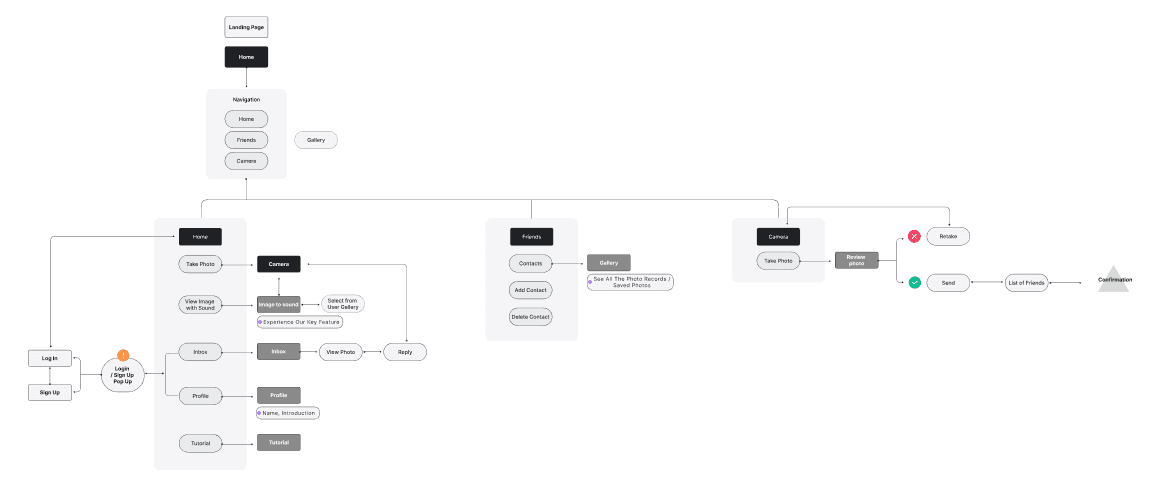
Seeing the overall layout of the app and how users will be navigating and exploring the app made the idea simpler and easier to start working on. The user flow was able to include some pages, buttons, and other necessities so the creation of the mock-up could be started with an outline and an idea of how to go about it.
Continuation
Over the course of a week or two, everyone contributed to the mock-up as well as their research and other projects, including the competitive analysis of other applications, accessibility plugin research, style guide creations, and the user persona. All these projects helped in the continuation of the big project, adding insight and often solving pain points that the target user often experiences such as inaccurately described videos and inaccessible features. The more the project continued, the more viable the project became. Members often saw how this app could actually work and help many visually impaired people of the world truly experience a photo and share it with their friends, just like seeing people can do. Recently, all team members agreed on a re-design. Perhaps changing the name of the app from PicTok to pic-o-pal but for sure changing the logo and colour theme. That is in the works. Everyone continues to work hard, eager to see what this app can look like and what it can fulfill within the lives of visually impaired people.